Photo: Santiago Cathedral, the Obradoiro façade by Fernando, CC BY-SA 4.0, via Wikimedia Commons

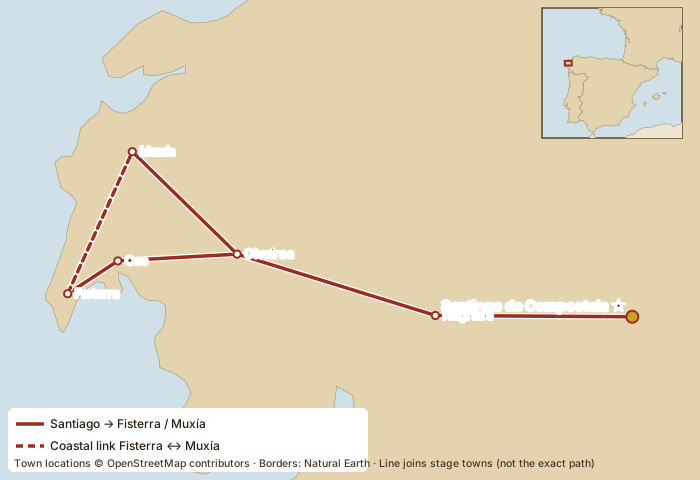
The only Camino that starts in Santiago. Pilgrims walk west to the Atlantic at Cape Fisterra, once thought the end of the known world, and to the Marian sanctuary of A Virxe da Barca at Muxía. Many walk a loop that takes in both.
⚠ Published distances vary (roughly 87–90 km to Fisterra, about 115–120 km if you add Muxía). Confirm on Gronze. Fisterra and Muxía issue their own certificates (the Fisterrana and the Muxiana).
Deep Dive
History and origins
Cape Fisterra (Finisterre, from finis terrae, "end of the earth") was seen by Romans as the western edge of the known world. A tradition says there was a Roman altar to the sun (Ara Solis) here, but no archaeological proof has been found. Medieval pilgrims who reached Santiago sometimes continued to the coast, and in 1479 a pilgrim hospital, Nosa Señora do Rosario, was founded at Fisterra. Muxía's sanctuary of A Virxe da Barca is tied to a legend that the Virgin Mary arrived in a stone boat to encourage St James while he preached; this is legend, not history. The stones by the shrine (Pedra de Abalar, Pedra dos Cadrís) are said to be pieces of that boat.
Unlike the other routes, this one is an epilogue: pilgrims walk it after reaching Santiago. Fisterra issues its own certificate (the Fisterrana) and Muxía the Muxiana; the Compostela itself is only given in Santiago.
Regions crossed
The route stays entirely in Galicia (province of A Coruña), heading west through the Tambre valley, rural farmland, eucalyptus woods and finally the rugged Costa da Morte ("Coast of Death"), named for its many shipwrecks. Galician is the everyday language. Seafood is the highlight: barnacles (percebes), octopus, fish stews and the fishing traditions of Fisterra and Muxía.
Elevation and landscape
This is a short walk of rolling hills, valleys and moorland, without big passes. After Olveiroa, the route splits: one branch heads to Cee and then along the coast to Fisterra; another heads north to Muxía. Some pilgrims walk the coastal link between the two. Expect wind, rain and dramatic ocean views. Distances are modest, but some stages are long with few services, especially between Negreira and Olveiroa, so plan water and food. The final approach to Fisterra follows a beach and the town's harbour before the last climb to the lighthouse on the cape.
Notable past travellers
- Leo of Rožmitál (1465–1467): a Bohemian nobleman whose journey was recorded by two companions, Václav Šašek and Gabriel Tetzel; the party went on from Santiago to Finisterre.
- Domenico Laffi (17th century): the Bolognese priest whose 1673 book was titled for both "S. Giacomo di Galitia" and "Finisterrae".
- Modern custom (tradition): burning clothes or boots at the cape at sunset is a modern pilgrim tradition, now discouraged for safety and environmental reasons.
Notable stops
- Santiago de Compostela: the starting point, with its cathedral and old town (World Heritage Site).
- Ponte Maceira: a medieval bridge and village over the Tambre, often called one of Galicia's most beautiful.
- Negreira: with the Pazo do Cotón and its arch.
- Olveiroa: a stone village with hórreos, where the route splits.
- Cee and Corcubión: where the sea first comes into view.
- Fisterra: the lighthouse at the cape and the km 0.000 marker.
- Muxía: the sanctuary of A Virxe da Barca on the rocks by the ocean.
- Cape Fisterra lighthouse (built in 1853): the place to watch the sun set over the Atlantic, the moment many pilgrims walk here for.
- Praia do Rostro and the coast north of Fisterra: wild beaches on the coastal link toward Muxía, with powerful currents; not safe for swimming.
- Lires: a small village on an estuary, the usual overnight stop on the coastal link between Fisterra and Muxía.
- Monte Corpiño near Muxía: a short climb behind the sanctuary with views over the whole Costa da Morte.
Sources
- Concello de Fisterra: the lighthouse (1853)
- Concello de Fisterra: Santa María das Areas and the 1479 pilgrim hospital
- The Travels of Leo of Rozmital, 1465–1467 (Routledge edition)
- Fundación Jacobea: Domenico Laffi (1673)
- UNESCO: Santiago de Compostela (Old Town)
- Xunta de Galicia official Camino site: Fisterra and Muxía Way
- Official Pilgrim's Office (Oficina del Peregrino)
- Pilgrim's Office: the Compostela certificate
- Cathedral of Santiago de Compostela (official)
- Oficina del Peregrino, statistics 2025 (route shares, via santiago.es summary)
- santiago.es: every Camino route side by side
- pilgrim.es route list · Seis Caminos route list
- Gronze.com (stage-by-stage planning)
⚠ Guides differ by a few kilometres because of variants and measuring methods. Distances are shown as ranges.
Last verified: October 15, 2026. Prices, hours and rules change: confirm with the official source before you go.