Photo: The Bidasoa at Irún by Zarateman, CC BY-SA 3.0, via Wikimedia Commons

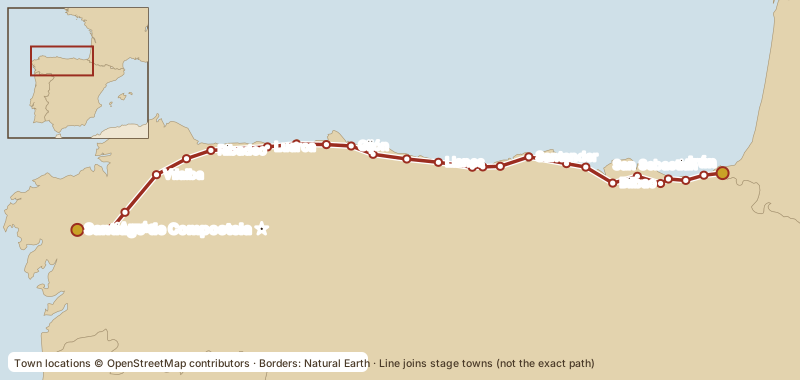
Cliffs, beaches and green hills through the Basque Country, Cantabria and Asturias, passing San Sebastián, Bilbao and Santander, then turning inland in Galicia. Tougher than the Francés (constant ups and downs) and much quieter; its share has fallen nine years running.
Good to know
- Fly into Bilbao, San Sebastián or Biarritz, then go to Irún.
- At Villaviciosa you can switch to the Primitivo via Oviedo.
Deep Dive
History and origins
In the early Middle Ages the Christian kingdoms of northern Spain held a narrow strip between the mountains and the sea, and pilgrims often followed the coast, where the roads were safer. Many arrived by sea at Cantabrian ports. As the Reconquista pushed south and the Francés became the main road in the 11th–12th centuries, the coastal way became less used, but it never disappeared: monasteries, hospitals and churches dedicated to St James line it. In 2015 UNESCO extended the Camino's World Heritage listing to the "Routes of Northern Spain", including the Norte.
Regions crossed
The Norte crosses four regions: the Basque Country (Gipuzkoa and Bizkaia), Cantabria, Asturias and Galicia. That means four distinct cultures and two regional languages besides Spanish: Basque in the east and Galician in the west, with Asturian (asturianu) present in between. Food is a highlight: San Sebastián's pintxos, Bilbao's bacalao al pil-pil, Cantabrian anchovies from Santoña and quesada pasiega, Asturian fabada, cider poured from a height (escanciado) and Cabrales cheese, then Galician octopus and Mondoñedo almond tart.
Elevation and landscape
Expect constant ups and downs rather than one great pass. The route switches between beaches, cliff paths, estuaries and green hills, with a few stretches through industrial towns. Some of the hardest climbs are in the Basque Country early on, where the path crosses steep ridges between fishing towns. After Ribadeo, the route turns inland into Galicia and climbs out of Mondoñedo, one of its stiffest climbs, before crossing the plateau of the Terra Chá. It joins the Francés at Arzúa for the final two days.
The variety is the attraction: one day may start on a beach and end in a mountain village. The trade-off is effort, since the path rarely stays level for long, plus some urban and industrial stretches around Bilbao, Santander, Gijón and Avilés. Several places offer alternatives, including bus or ferry links to bypass the less attractive suburbs. Rain is common at any season; the coast is greener for it.
Notable past travellers
Few individual pilgrims on the Norte are documented by name; the record lies mainly in the hospitals, monasteries and churches founded for pilgrims along the coast. Many pilgrims also detoured from the Norte to Oviedo to join the Primitivo, following the medieval saying about visiting "the Saviour" (see Camino Primitivo).
Notable stops
- Irún: border town on the Bidasoa, facing Hendaye in France.
- San Sebastián (Donostia): the shell-shaped Concha bay and its old town full of pintxo bars.
- Zarautz, Getaria and Deba: a dramatic stretch of coast; Getaria was home of Juan Sebastián Elcano, who completed the first circumnavigation.
- Gernika: symbolic town of the Basques, with its oak tree and the memory of the 1937 bombing.
- Bilbao: the Guggenheim Museum and the old Casco Viejo with the cathedral of Santiago.
- Santander: a ferry crossing of the bay and the capital of Cantabria.
- Santillana del Mar and Comillas: a medieval village (near the Altamira cave, on the UNESCO list) and Gaudí's El Capricho.
- Llanes and Ribadesella: Asturian fishing towns below the Picos de Europa.
- Ribadeo: the bridge over the Eo estuary into Galicia, near the Beach of the Cathedrals (Praia das Catedrais).
- Mondoñedo: an old episcopal town with a fine cathedral.
- Sobrado dos Monxes: a large Cistercian monastery, still with monks, which hosts pilgrims.
- Gijón and Avilés: Asturias's largest coastal cities; Gijón has the Roman baths of Campo Valdés.
Sources
- UNESCO: Routes of Santiago de Compostela: Camino Francés and Routes of Northern Spain
- UNESCO: Cave of Altamira and Paleolithic Cave Art of Northern Spain
- UNESCO: Santiago de Compostela (Old Town)
- Xunta de Galicia official Camino site: Northern Way
- Official Pilgrim's Office (Oficina del Peregrino)
- Pilgrim's Office: the Compostela certificate
- Cathedral of Santiago de Compostela (official)
- Oficina del Peregrino, statistics 2025 (route shares, via santiago.es summary)
- santiago.es: every Camino route side by side
- pilgrim.es route list · Seis Caminos route list
- Gronze.com (stage-by-stage planning)
⚠ Guides differ by a few kilometres because of variants and measuring methods. Distances are shown as ranges.
Last verified: October 15, 2026. Prices, hours and rules change: confirm with the official source before you go.