Photo: Porto, the Ribeira on the Douro by Jakub Hałun, CC BY 4.0, via Wikimedia Commons

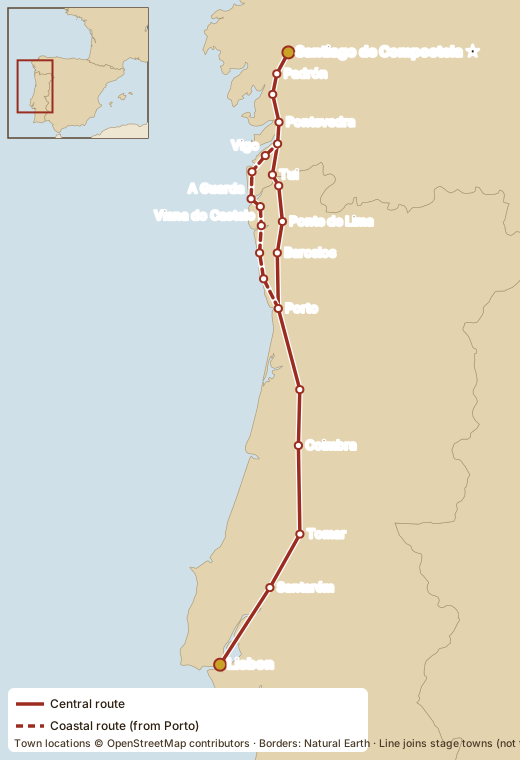
The second most popular Camino, now more than a third of all pilgrims. Most start in Porto (10–13 days). The Central route goes inland through Barcelos and Ponte de Lima and crosses into Spain at Valença/Tui; the Coastal route follows the Atlantic through Vila do Conde, Viana do Castelo and A Guarda. A Spiritual Variant from Pontevedra includes a boat stretch up the Ría de Arousa.
Good to know
- Fly into Porto (OPO) or Lisbon (LIS).
- Short version: Tui → Santiago, ~116 km in 5–6 days.
- Gentler terrain than the Francés; plenty of cobblestones in Portugal.
Deep Dive
History and origins
Pilgrims from Portugal have walked to Santiago since the Middle Ages, along roads that often followed the old Roman route between Lisbon (Olisipo), Braga (Bracara Augusta) and Astorga. The kingdom of Portugal itself took shape in the 12th century, and its kings and queens kept close ties with the shrine. The best-known royal pilgrim is Queen Isabel of Portugal (St Elizabeth of Portugal), who went to Santiago in 1325 after her husband King Dinis died and gave her crown to the cathedral, receiving a pilgrim's staff and scrip from the archbishop. A second, humble pilgrimage on foot in 1335 is told in later chronicles, but it is undocumented and recent studies suggest it may be a chronological error. Medieval pilgrims also travelled north on the coastal roads, where towns such as Vila do Conde and Viana do Castelo were already busy seaports. The modern revival is recent: the Portuguese Way is now the second most walked route.
Regions crossed
From Lisbon the Central route runs up the Ribatejo and Centro regions past Santarém, Tomar and Coimbra to Porto, then through the green, vine-covered Minho, crossing the Minho river at Valença/Tui into Galicia (the province of Pontevedra, then A Coruña). The Coastal route follows the Atlantic through Vila do Conde and Viana do Castelo to A Guarda and Vigo. Portuguese and Galician are close cousins, and many pilgrims notice how easily the languages blend at the border. Highlights at the table: Porto's francesinha and tripe (tripas à moda do Porto), Minho's vinho verde and caldo verde, bacalhau in countless forms, and on the Galician side Padrón peppers (from the town on the route), Albariño wine and seafood of the Rías Baixas.
Elevation and landscape
This is the gentlest of the long routes. Most of it is lowland farmland, eucalyptus and pine woods, river valleys and coastal paths. The one real climb on the Central route from Porto is the Portela Grande de Labruja, a forested pass of roughly 400 m between Ponte de Lima and Rubiães. The Coastal route stays close to sea level, with boardwalks, beaches and a few headlands. Expect cobblestones in towns and some stretches on paved roads; the coastal variant can be windy.
Notable past travellers
- Queen Isabel of Portugal (1325): her pilgrimage and gifts to the cathedral are documented; the story of a second pilgrimage on foot in 1335 is unverified.
- King Manuel I of Portugal (1502): made a documented, largely private pilgrimage from Lisbon via Coimbra, Porto and Valença, and gave the cathedral a silver lamp to burn before the high altar.
- Giovanni Battista Confalonieri (1594): an Italian cleric whose manuscript account (in the Vatican Library) records his walk from Lisbon to Santiago via Coimbra, Porto, Barcelos, Ponte de Lima and Tui.
Notable stops
- Lisbon: the Sé (cathedral) is the traditional start for the full route.
- Tomar: the Templar castle and Convent of Christ, a World Heritage Site.
- Coimbra: Portugal's old university city, also a World Heritage Site, and the burial place of Queen Isabel at the Monastery of Santa Clara-a-Nova.
- Porto: the most popular start, with its cathedral and riverside Ribeira (historic centre listed by UNESCO).
- Barcelos: home of the legend of the Barcelos rooster, which crowed to save a falsely accused pilgrim (a legend close to that of Santo Domingo de la Calzada).
- Ponte de Lima: one of Portugal's oldest towns, with its long medieval and Roman-era bridge over the Lima.
- Tui: a fortress cathedral on the Spanish bank of the Minho, facing Valença.
- Pontevedra: the scallop-shell-shaped church of the Virxe Peregrina, dedicated to the Pilgrim Virgin.
- Padrón: where tradition says the boat bearing St James's body moored; the stone pedrón is kept under the altar of Santiago church.
- Caldas de Reis: a spa town with hot springs, where local tradition places the birth of King Alfonso VII in 1105 (historians confirm only that he was born in Galicia).
- Vigo and A Guarda (Coastal route): A Guarda's Monte de Santa Trega has a Celtic hillfort (castro) overlooking the mouth of the Minho.
Sources
- Ad Limina XI: Paulo Catarino Lopes on Portuguese late-medieval routes (Queen Isabel, 1325/1335)
- University of Santiago: Manuel I's 1502 pilgrimage
- eViterbo (NOVA Lisbon): Manuel I's silver lamp for Santiago
- Vatican Library: Confalonieri manuscript, Reg. lat. 1594
- Confalonieri's pilgrimage of May 1594 (Comarcas na Rede)
- Guiarutas: Ponte de Lima–Rubiães (Portela Grande de Labruja, 399 m on the official trace)
- Xacopedia: Alfonso VII (birthplace tradition)
- UNESCO: Historic Centre of Oporto
- UNESCO: University of Coimbra
- UNESCO: Convent of Christ in Tomar
- UNESCO: Santiago de Compostela (Old Town)
- Xunta de Galicia official Camino site: Portuguese Way
- Xunta de Galicia official Camino site: Portuguese Coastal Way
- Official Pilgrim's Office (Oficina del Peregrino)
- Pilgrim's Office: the Compostela certificate
- Cathedral of Santiago de Compostela (official)
- Visit Portugal (official tourism): Caminhos de Santiago
- Oficina del Peregrino, statistics 2025 (route shares, via santiago.es summary)
- santiago.es: every Camino route side by side
- pilgrim.es route list · Seis Caminos route list
- Gronze.com (stage-by-stage planning)
⚠ Guides differ by a few kilometres because of variants and measuring methods. Distances are shown as ranges.
Last verified: October 15, 2026. Prices, hours and rules change: confirm with the official source before you go.