John 1:1
Alignment: 5/5 for the words, 4/5 for nuance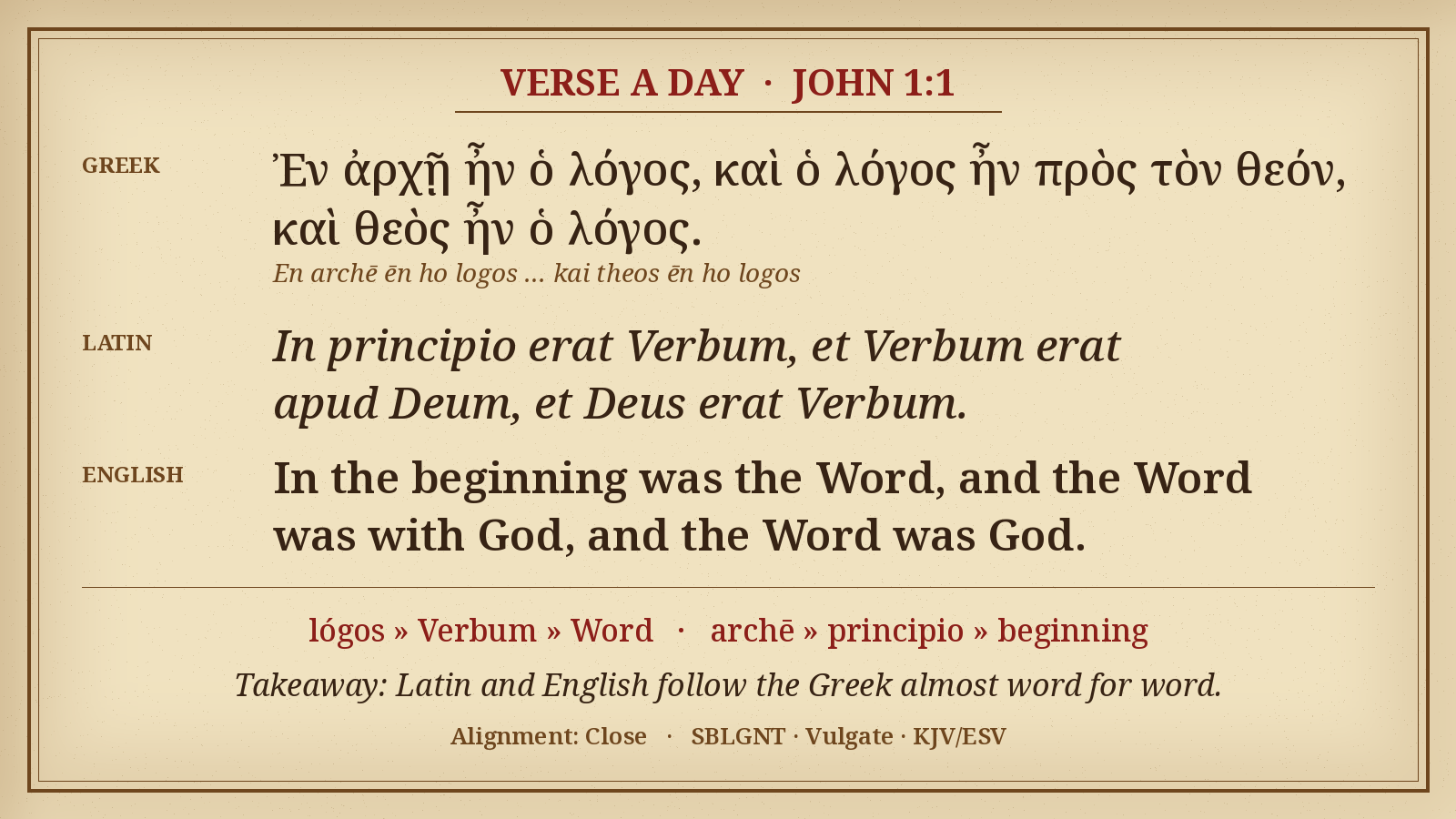

Four witnesses
Key words
- logos → Verbum → Word. Logos means "word," and also reason or the ordering principle of the universe in Greek philosophy. Jerome's Verbum keeps "word" but loses the "reason" side. English follows the Latin.
- archē → principio → beginning. "En archē" echoes Genesis 1:1 in the Greek Septuagint (Ἐν ἀρχῇ ἐποίησεν ὁ θεός). The Vulgate's Genesis likewise starts "In principio." All three languages keep that echo.
- pros ton theon → apud Deum → with God. Pros suggests being "toward" or "face to face with" someone. Apud means "in the presence of," and "with" is the flattest of the three.
- theos with and without "the." The Greek has ton theon ("the God") in clause 2 but theos with no article in clause 3, placed first for emphasis. Grammarians (Colwell's rule, Harner 1973) read the bare theos as describing what the Word is: fully divine in nature, but not the same person as "the God" just mentioned. That is why "the Word was God" is the standard reading. The New World Translation's "a god" is rejected by most scholars. Moffatt ("the Logos was divine") and the NEB/REB ("what God was, the Word was") try to bring out the nuance. Latin has no articles at all, so Deus erat Verbum can't show the distinction. Jerome also kept the Greek word order, while English moves "the Word" to the front.
Alignment
5/5 for the words, 4/5 for nuance. Every word maps one to one. The only things lost are the article distinction, the "toward" sense of pros, and the philosophical range of logos.
The story
In his 1516 Greek New Testament, Erasmus replaced Verbum with Sermo in his new Latin translation ("In principio erat sermo"), arguing that logos means living speech or discourse. Critics accused him of tampering with Scripture, and he wrote a long defense, the Apologia de In principio erat sermo.
Sources
SBLGNT and Nestle 1904 via BibleHub parallel texts (biblehub.com/texts/john/1-1.htm). Vulgate (Clementine/Stuttgart; biblehub.com/vul/john/1.htm). KJV (public domain). ESV (esv.org/John+1/).

✉ Get the Daily Word by email (free)
One New Testament verse each morning, with the scene, the Greek, Latin and English, and a story.