John 3:16
Alignment: Some drift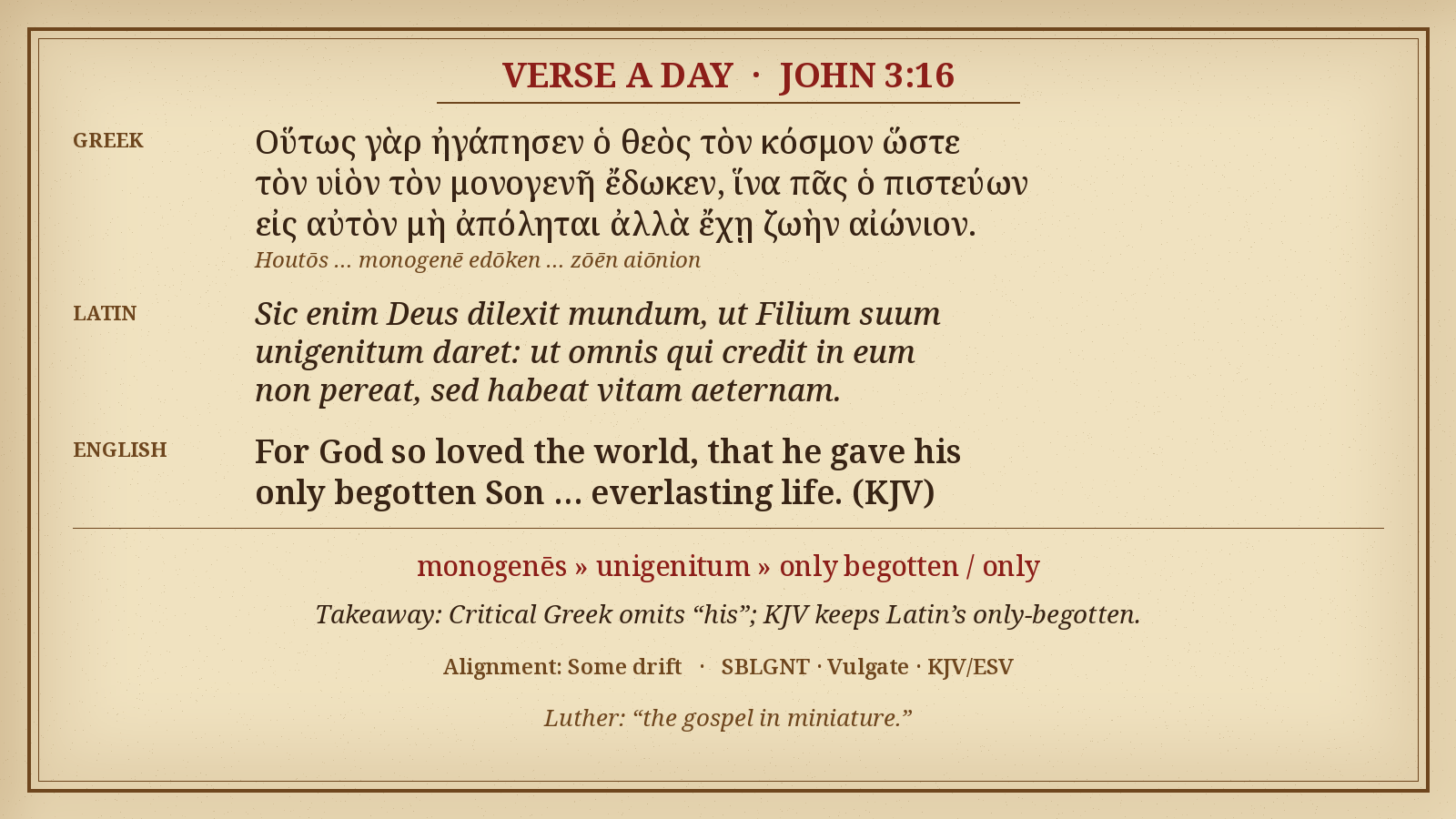

Four witnesses
Key words
- μονογενῆ (monogenē) → unigenitum → only begotten / only. Literally "one of a kind" or "unique." Jerome's unigenitum ("only-begotten") shaped the KJV. The ESV drops "begotten" and says "only Son," following the sense of uniqueness rather than a birth metaphor.
- οὕτως … ὥστε (houtōs … hōste) → sic … ut → so … that. Houtōs can mean "in this way" (manner) as well as "so much" (degree). The ESV footnote offers "For this is how God loved the world." Latin sic and English "so" lean toward the degree reading most people hear.
- ἠγάπησεν (ēgapēsen) → dilexit → loved. Aorist of agapaō: a decisive act of love, not a mood. Latin dilexit is Jerome's usual verb for that love. English "loved" carries it cleanly.
Alignment
Some drift. The big picture matches. Two places wobble: (1) critical Greek (SBLGNT) has "the only Son" without autou ("his"), while the Byzantine/Textus Receptus, Vulgate (suum), and KJV all keep "his"; (2) monogenēs becomes "only begotten" in Latin/KJV and plain "only" in the ESV.
The story
Martin Luther called John 3:16 "the gospel in miniature." Centuries later, when Tim Tebow wrote "John 3:16" in eye black for the 2009 BCS championship, it became the most-searched Bible verse on Google overnight — about 90 million people looked it up.
Sources
SBLGNT via Bible Hub (biblehub.com/texts/john/3-16.htm). Clementine Vulgate (biblehub.com/vul/john/3.htm). KJV (public domain). ESV (biblegateway.com).

← John 1:1 · Archive · Matthew 6:9 →
✉ Get the Daily Word by email (free)
One New Testament verse each morning, with the scene, the Greek, Latin and English, and a story.