Matthew 6:10
Alignment: Some drift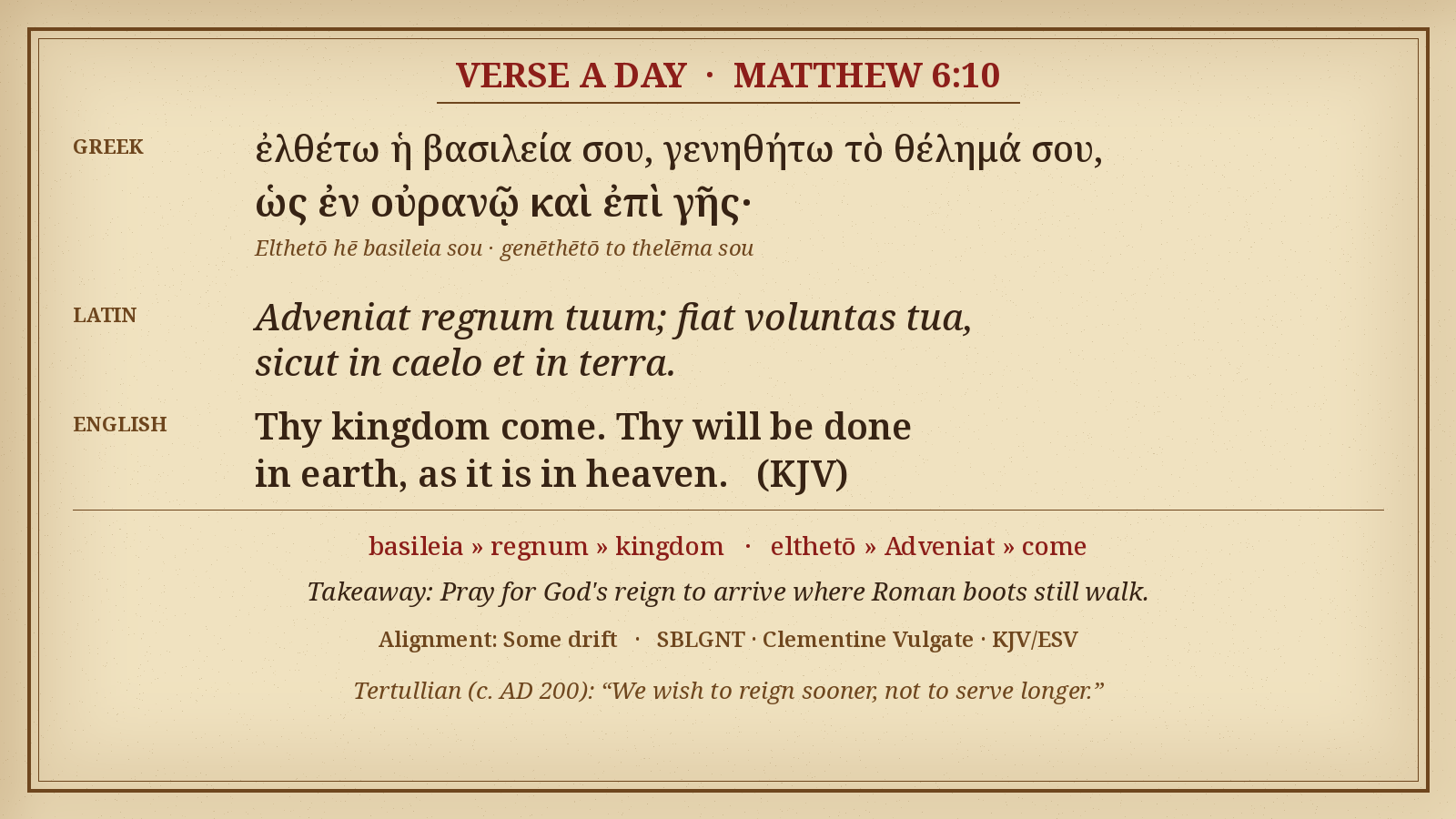
Setting the scene
Same hillside above the Sea of Galilee, near Capernaum, around AD 28–30, still early in Jesus' Galilean ministry and still in the Sermon on the Mount. The disciples and the crowd have just heard him teach them to start prayer with "Our Father." Now come the next two lines. These listeners live under Rome: Herod Antipas holds Galilee for Caesar, and many Jews longed for a Davidic Messiah who would restore Israel's kingdom and push the empire out. First-century prayers and writings (like the Psalms of Solomon) asked God to raise up that king. So when a young rabbi from Nazareth tells them to pray "Your kingdom come," they would have heard something electric. He does not name a rebel army or a throne in Jerusalem. He asks them to want God's reign, and God's will, the way heaven already has it, right here on the ground where Roman boots still walk.

Four witnesses
Key words
- basileia → regnum → kingdom. Basileia means both "kingdom" (a realm) and "kingship" (a reign). English "kingdom" tilts toward territory; the Greek leans just as much toward God's active rule. Jerome's regnum carries both senses well. For a first-century Jew under Rome, "kingdom" was not abstract: it was hope that God would finally put things right.
- elthetō → Adveniat → come. An aorist imperative: "let it come," a sharp, decisive ask, not a vague wish. Latin Adveniat ("may it arrive") keeps the urgency. This is a petition for God's reign to break in, not a polite nod that it already exists somewhere else.
- thelēma / genēthētō → voluntas / fiat → will / be done. Thelēma is what God wants; genēthētō is another aorist passive imperative, "let it come to pass." Jerome's famous fiat ("let it be done") is the same root as Mary's fiat in Luke 1:38. The line asks that God's purposes land on earth the way they already run in heaven.
Alignment
Some drift. Greek and Latin keep the order "as in heaven, also on earth" (hōs en ouranō kai epi gēs / sicut in caelo et in terra). English flips it to "on earth as it is in heaven," which is clearer for English ears but reverses the Greek sequence. The KJV's older "in earth" becomes "on earth" in the ESV. Sense stays the same; word order does not.
The story
Around AD 200, Tertullian of Carthage, in the earliest surviving commentary on the Lord's Prayer (De Oratione), refused to soft-pedal this line. Christians who prayed for the world to last longer, he said, were praying against their own hope. "We wish to reign sooner, not to serve longer." His punch line still stings: "Yes, let thy kingdom come, O Lord, as speedily as may be." The petition was never meant to be tame.
Sources
SBLGNT via Bible Gateway and Bible Hub (biblehub.com/text/matthew/6-10.htm). Clementine Vulgate (biblehub.com/vul/matthew/6.htm). KJV (public domain). ESV. Tertullian, De Oratione 5 (newadvent.org/fathers/0324.htm).

✉ Get the Daily Word by email (free)
One New Testament verse each morning, with the scene, the Greek, Latin and English, and a story.