Matthew 6:9
Alignment: Close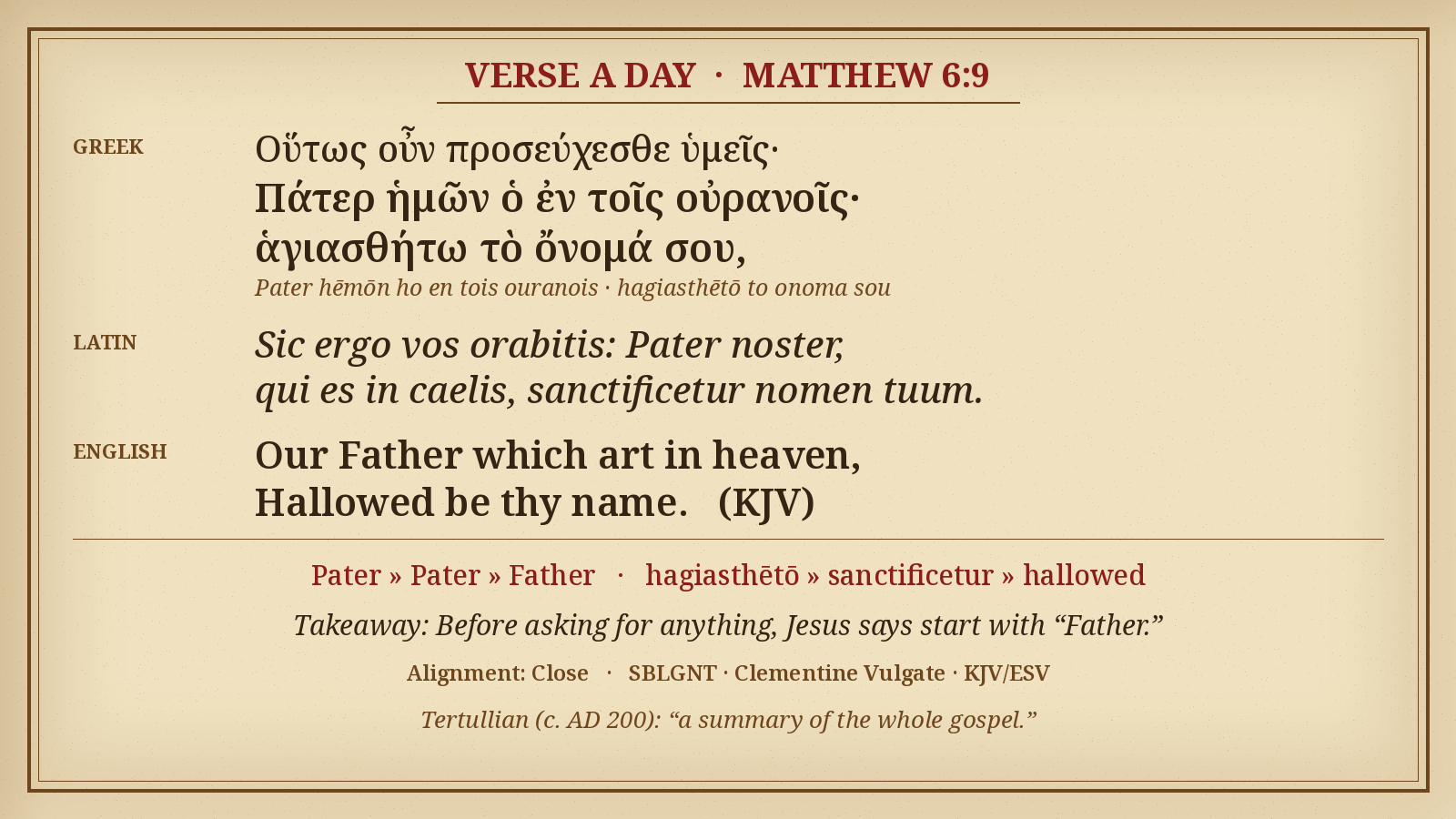
Setting the scene
Picture a hillside above the Sea of Galilee, near the fishing town of Capernaum, somewhere around AD 28–30, early in Jesus' Galilean ministry. A carpenter's son from Nazareth, maybe in his early thirties, has sat down on the slope the way rabbis did to teach. His newly called disciples (fishermen like Peter, Andrew, James and John) sit closest, and behind them a crowd from Galilee, the Decapolis, Jerusalem and Judea (Matthew 4:25–5:1). These are Jews living under Rome: Herod Antipas rules Galilee as Rome's client, Roman soldiers garrison Judea, and the tax burden is part of everyday life. Many of them hoped for a Messiah who would be a son of David, a warrior-king who would throw off the Romans and restore Israel's kingdom. Some first-century BC writings, like the Psalms of Solomon, prayed for exactly that. Nobody on that hill yet knew fully who this man was. Then, in the middle of a sermon about not praying for show, he does something surprising. Instead of a battle plan, he gives them a prayer, and it starts by calling the God of Israel "our Father."

Four witnesses
Key words
- Pater hēmōn → Pater noster → Our Father. The Greek puts "Father" first and "our" second, and Latin keeps that order, which is why the Latin prayer is called the Pater Noster. Behind the Greek is most likely the Aramaic Abba, the family word Jesus himself used in Gethsemane (Mark 14:36). Israel had called God Father before (Isaiah 63:16), but making it the first word of everyday prayer was new and personal. The "our" makes it a family prayer, never just "my."
- hagiasthētō → sanctificetur → hallowed be. A passive command: "let your name be treated as holy." It asks God to show his own holiness, and asks that people honor it. Jerome's sanctificetur ("may it be made holy") carries it faithfully. "Hallowed" is the old English word for "made holy," the same root as Halloween (All Hallows' Eve). The line closely echoes the Jewish Kaddish, a synagogue prayer whose roots likely reach back to Jesus' day: "Magnified and sanctified be his great name."
- onoma → nomen → name. To a Jewish listener, God's "name" meant more than a label: it stood for his character, reputation and presence (Exodus 34:5–7). Greek, Latin and English all keep that one simple word.
Alignment
Close. All three line up nearly word for word. The only small shift is that Greek and Latin say "in the heavens" (plural: ouranois, caelis), while English smooths it to "heaven." Jerome's "qui es" ("who art") is the source of the KJV's "which art."
The story
The Didache, a short Christian handbook usually dated to the late first century, already quotes this prayer almost exactly as Matthew has it and tells believers to pray it three times a day. It even adds a closing line, "for thine is the power and the glory forever," an early form of the doxology many churches still say. Around AD 200, Tertullian of Carthage wrote the earliest surviving commentary on the prayer and called it "breviarium totius evangelii," a summary of the whole gospel.
Sources
SBLGNT via Bible Hub (biblehub.com/texts/matthew/6-9.htm). Clementine Vulgate (biblehub.com/vul/matthew/6.htm). KJV (public domain). ESV. Didache 8:2–3 (newadvent.org/fathers/0714.htm). Tertullian, De Oratione 1.

← John 3:16 · Archive · Matthew 6:10 →
✉ Get the Daily Word by email (free)
One New Testament verse each morning, with the scene, the Greek, Latin and English, and a story.